

The Panther That Wasn't There
What happens when a revolutionary brand outruns the reality behind it

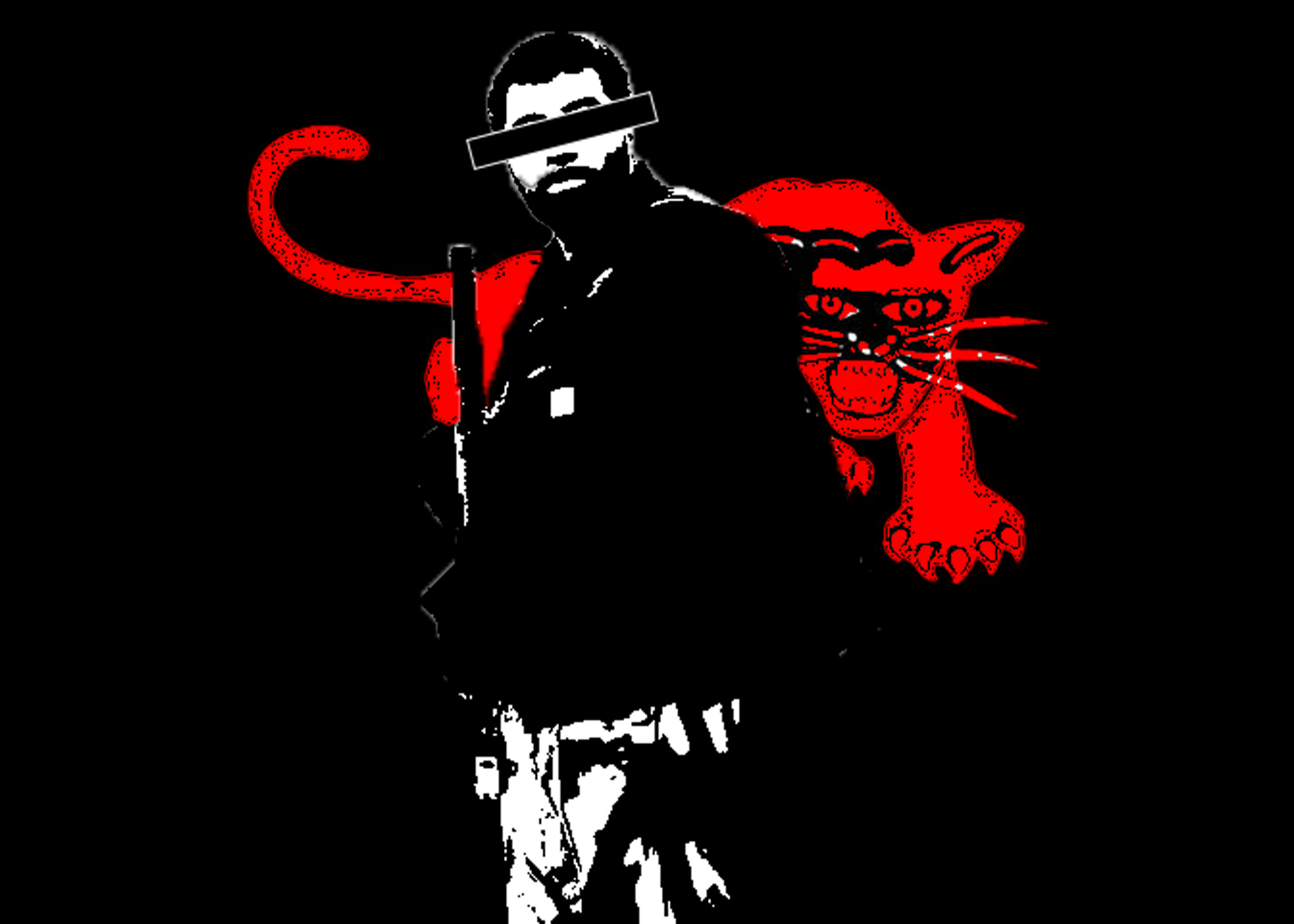
Update : As of January 26th 2025, The posted 10 Point Program from Birdsong has been retracted and updated.
Update : Franklin “Jomo” Shuford, has reached out to announce a statement on the situation.
On a cold January afternoon, a line of black‑clad people stood in the gray light outside City Hall in Philadelphia, rifles slung, patches on their chests. The cameras did what cameras always do: they found the man in the middle, the one speaking in long, practiced runs about history, sacrifice, and the return of a name that was never supposed to die.
He called himself Chairman Paul Birdsong of the Black Panther Party for Self‑Defense. He said his formation had seventeen chapters across the United States, that they were trained, disciplined, and authorized by surviving veterans of the original party. To the people watching on phones and news sites, the message was clear enough: the Panthers are back, and they are on the street again.
But nobody stopped to ask what he has built and how much of what people think they are seeing exists anywhere beyond his own narration.
What He Claims
In his own account, Paul Birdsong’s story starts long before that fateful Thursday at Philadelphia City Hall.
He describes growing up inside Bloods culture, the son of a man he says helped found a West Side Piru affiliate in Los Angeles. In a 2020 profile from Lansing, Michigan, where he first comes into view as a protest leader, he presents himself as a multi‑state gang organizer who tried to keep his people off hard drugs and out of prison. Local reporters confirm that he was visibly armed at protests at the Michigan State Capitol following the murder of George Floyd and that he emerged as a central figure in an extended Capitol occupation that lasted months. Birdsong says that occupation is where he began to shift. In a long interview recorded on June 4th, 2020, he talks about tying his red flag to those of other gangs during the protests, then abandoning colors altogether, dressing in black, and deciding to act as a “revolutionary” rather than as a gang leader. He describes this not as a clean break but as an ongoing psychological struggle, a habit of mind he has to consciously replace.
From there, his origin story turns toward the Panthers. He claims that during or after the Lansing occupation he and his associates were recruited into something called the New Age Panther Party, supposedly connected to Franklin “Jomo” Shuford, a documented former Los Angeles Panther. He says he then heard from Elmer Dixon via Instagram, was introduced to original Seattle Panther Aaron Dixon, and told that elders wanted to guide his work. According to Birdsong, this relationship deepened. He says he asked Aaron Dixon directly if his formation could call itself the Black Panther Party and was told yes. He says that through another veteran, Clarence Peterson, they contacted Emory Douglas, the original party’s artist, and were granted permission to use the panther logo. He names other historic figures : Billy J. Brooks, Barbara Easley and etc. as mentors or supporters.
By the time his group appears in January 2026, Birdsong is claiming:
A Black Panther Party for Self‑Defense with seventeen chapters across multiple states, grown from early bases in Michigan, California, South Carolina, and North Carolina to newer presences in Philadelphia, Alabama, Arizona, Las Vegas, New York, and New Jersey.
A structured membership pipeline in which prospects attend events, are evaluated, and then undergo eighteen months of political education, physical training, and firearms instruction before carrying weapons at actions.
A political education curriculum that includes Mao’s writings, the original Panther Ten‑Point Program, and materials on Marxism‑Leninism and dialectical materialism, as well as practical certifications like CPR and food safety.
Ideologically, he puts forward a “United Empires Panther Party for Self‑Defense Ten Point Program.” It demands the power to establish a homeland for descendants of America’s slaves, insists on a distinct ethnic identity for that lineage, calls for reparations and tax exemption for that group, and outlines federal programs for housing, education, and “felony forgiveness.” It also demands “exemption from all anti 2nd amendment legislation” and “black police in black communities,” with police allowed to patrol only where they live.
Around this, Birdsong builds a narrative of continuity: that his formation carries forward the discipline, sacrifice, and armed defense of the historic Panthers, sanctioned by veterans, using their imagery with their blessing.
That is the story many people saw. It is not the whole story.
What Actually Exists
When you strip away the narration and look at what can be documented, a smaller, more complicated picture emerges.
The Lansing City Pulse and other local outlets confirm key parts of Birdsong’s early role. They identify him as a central organizer in protests at the Michigan Capitol after George Floyd’s killing, describe hundreds of people lying down for nine minutes at his direction, and show him openly armed. They also document at least one weapons‑related incident during those marches: a man named Gregory Maurice Richardson was charged with brandishing a firearm while marching with Birdsong’s group. Birdsong himself was not charged in that case.
The same reporting records his self‑presentation as a gang leader with multi‑state reach and a stated commitment to keeping his people alive and out of prison. That much appears on paper; there is, at present, no independent confirmation from law enforcement or gang sources about the scope of his claimed authority inside Bloods structures. What happens inside the occupation, the recruitment into the New Age Panther Party, the nature of that group, the depth of his relationship with Jomo, is known only from Birdsong’s own account and scattered online discussions referencing the same interview and profile. No independent organizational record for the New Age Panther Party has been located in public filings or archives (Besides a group in Atlanta).
There is evidence that Birdsong made contact with at least one original Panther.
Video segments circulated on Reddit and other platforms show Aaron Dixon on camera with Birdsong in January 2026, discussing the proliferation of groups using the Black Panther Party name. In that footage, Dixon criticizes the number of organizations calling themselves Panthers, warns that you cannot know who to trust just from the label, and insists that time and practice reveal who is serious. He names other formations he considers untrustworthy and emphasizes that he prefers to build with people he knows personally. But never fully admits that Birdsongs formation is one he trusts or supports.
Then in another video posted on Instagram, Birdsong reads a statement he attributes to himself and Dixon. It defends the original party’s record on drugs, sexism, internal discipline, and funding, and then shifts into present tense to describe current practices, including physical exercises and “eating knuckles” as forms of discipline. Birdsong then moves into his own language about the Black Panther Party for Self‑Defense protecting Black communities “by any means necessary.” What is missing from the public record is the piece Birdsong relies on most heavily:
an explicit, independent statement from Dixon saying he authorized the use of the Black Panther Party name and that Birdsong’s group is a legitimate continuation of the organization.
As of January 25, 2026, no such statement has been located. Nor is there any public confirmation from Emory Douglas that he granted permission to use the logo, or from the other named elders affirming that they recognize Birdsong’s formation as the Panther Party. On January 25, Birdsong released an Instagram reel saying that Dixon had messaged him withdrawing all support, describing the current dispute as “unimportant” and instructing him to make a video about elders coming to support him before backing away. Birdsong says he retains messages showing earlier permission and will keep them in case Dixon denies it publicly. Dixon has not, at this writing, issued the promised statement about no one calling themselves Panthers going forward. For now, everything about the supposed authorization and its withdrawal rests on Birdsong’s presentation of private communication.
The claim of seventeen chapters is similarly fragile.
In his January interview, Birdsong outlines a growth pattern: initial bases in Lansing and a few southern and western states, followed by rapid expansion into cities like Philadelphia, Las Vegas, and New York in 2023–2025. He describes a tight training pipeline and says only some members carry weapons publicly because many are still in training. But when I looked for more info on this I could not find is independent evidence of a functioning multi‑state structure on that scale. There are social media accounts that identify as chapters in some of the listed locations, but they largely appear in late 2025 and have limited, short‑term activity. There are no publicly accessible nonprofit registrations, corporate filings, or long‑standing partnerships with community organizations that match his description of a seventeen‑chapter network. That does not prove such a network does not exist in any informal sense. It does show that, from the outside, there is no way to verify it beyond Birdsong’s words and the images his group selects to release.
The Minneapolis Moment and After
On January 7, 2026, ICE agent Jonathan Ross shot and killed Rene Good, a 37‑year‑old U.S. citizen, mother of three, in Minneapolis. DHS initially claimed she had tried to use her vehicle as a weapon. A 3D ballistic reconstruction released by Index on January 20 indicated that Ross was not in the path of her car and was not in immediate danger when he fired into the vehicle. An FBI agent, Tracee Mergen, resigned after saying her effort to investigate the shooting was blocked.
Birdsong’s Philadelphia‑based formation traveled to the city hall that evening and appeared in armed formation at protests, drawing the attention of local and national media. Their presence, and Birdsong’s Panther branding, quickly became part of the story.
On January 7th, a veteran of the original Black Panther Party, Sadiki Olugbala, posted a mandate online, addressed “to all groups and people using the Black Panther Party name and or logos,” requiring that anyone using the name comply with their conditions by February 1. Sadiki, a veteran BPP member, is based in New York City. I reached out to Sadiki for comment, but was not able to get a response back. But for Birdsong’s group, the message they received was blunt: whatever they believed about their authorization, some of the BPP veterans did not recognize them as legitimate by default.
Over the next few days, a woman identifying herself as Huey P. Newton’s niece, Myesha Newton, released a video saying she intended to obtain a cease‑and‑desist order and sue Birdsong’s group for using and defaming her uncle’s name, displaying documents she said proved her family connection. Rico Dukes, who claims to be Newton’s biological son, responded by arguing that the Black Panther Party trademark had lapsed, that Myesha had no standing, and that he had personally given Birdsong’s chapter permission to use the name. As of late January, no actual lawsuit had been filed, and no court had weighed in on the competing claims.
It is in that context, armed presence at a nationally visible protest, a public mandate from veterans, and legal threats from Newton’s relatives, that led Birdsong to sit down and hold a live interview on January 24th with Black Power Media, presenting the most expansive version of his story, and then, within about a day, announced that Aaron Dixon had withdrawn support and that the group would rebrand as the Black Lion Party for International Solidarity, dropping the Panther name and imagery.
The Black Panther Name and Symbolism
The Black Panther Party’s name and imagery did not appear out of nowhere, and they are not just a generic signifier of black militancy.
The panther symbol associated with the Panthers was developed in the mid‑1960s, drawing on earlier use by the Lowndes County Freedom Organization in Alabama, and refined by the party’s Minister of Culture, Emory Douglas. It appeared in newspapers, on posters, and on the walls of free breakfast programs, medical clinics, and political education classes. It signaled not only armed self‑defense but a specific program of socialist politics, survival programs, and community organizing under a disciplined, often contentious central leadership. From early on, the state understood the power of that image. COINTELPRO files show how law enforcement targeted Panthers in part because of the threat they posed as a visible, organized symbol of Black self‑defense and political education, not just because of individual acts of violence. Over decades, as the original party splintered and veterans moved into other work, the panther image floated free into popular culture: on T‑shirts, in films, in art.
Birdsong’s formation did more than borrow aesthetics. By calling itself the Black Panther Party for Self‑Defense, referencing the original Ten‑Point Program, and invoking figures like Huey Newton and Bobby Seale, it laid claim to that specific lineage. The United Empires Ten Point Program and the organization’s actual practice tell a more complicated story.
The United Empires program centers the descendants of American slaves as a distinct ethnicity and calls for a homeland for that lineage inside the United States, alongside reparations, tax exemption, and targeted federal programs. It explicitly demands “exemption from all anti 2nd amendment legislation” and local policing tied to residency, and lists a federally funded “felony forgiveness” scheme that blends reentry support with job training. These demands overlap with, but are not identical to, the original Panthers’ emphasis on employment, housing, community control of police, and opposition to imperialist wars.
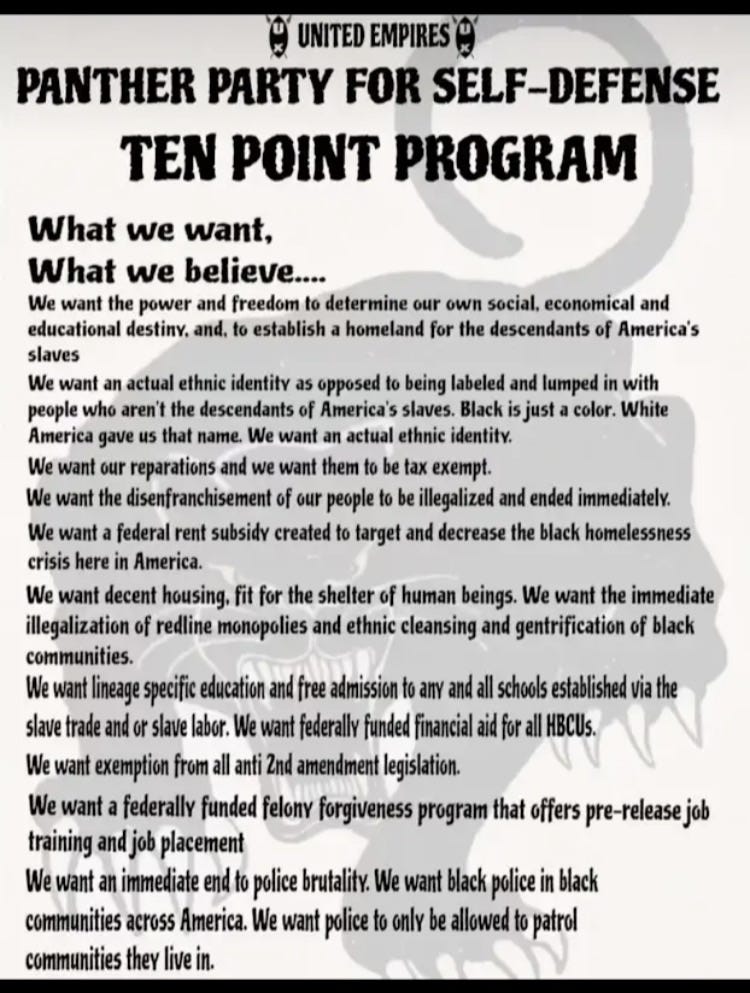
That does not make the new program illegitimate by default. It does mean that when Birdsong uses the Panther name and imagery, he is not simply reviving an old program, he is attaching the authority of a historic party to a different project , one whose details most people will never see beyond the logo and the rifles. But this doesn’t happen in a vacuum.
Over the past decade, the internet has made it easier than ever to build organizations first as narratives and only later, if at all, as institutions. It is now possible to declare the existence of a national formation, populate it with chapters on social media, and backfill the story with selectively edited images, testimonials, and long monologues about discipline and sacrifice. In many cases, the story becomes more real to distant supporters than any on‑the‑ground structure.
Birdsong’s formation fits this pattern in several ways:
Myth before structure : The claim of seventeen chapters, an elder council, and a strict training regime precedes any publicly verifiable network of organizations, filings, or partnerships on that scale.
Symbol before accountability : The Panther name and logo are deployed ahead of any clear, public confirmation from the elders invoked as authorities, and are dropped as soon as veteran opposition and legal threats begin to close in.
Trauma as stage : The killing of Rene Good, and the Minneapolis protests that followed, become the backdrop for the most visible performance of the group’s identity. The cameras capture armed uniforms and old slogans faster than they capture the forensic evidence, the obstructed investigation, or the daily lives of Good’s death and her family.
But let me be clear : This is not unique to Birdsong. Across the spectrum, we see groups using the costumes and language of past movements to confer instant legitimacy on projects that are, in practice, small, new, or largely virtual. History becomes a set of symbols to be laundered and reapplied. Real grievances like police killings, ICE shootings, housing crises, have become the raw material for brand‑building as much as for organizing.
The risk is not only that some leaders are exaggerating. It is that the gap between image and structure becomes so wide that people inside and outside the orbit of these formations cannot tell what is solid and what is smoke.
Why It Matters
When I look back at this entire saga I can pinpoint three ways that this gap has done damage, and the lessons we can maybe understand about organizing.
First, people can be pulled into something that is thinner than it appears. Prospects and supporters who think they are joining a nationally sanctioned continuation of the Black Panther Party may, in fact, be entering a small, loosely structured group whose key claims about authorization, chapters, and confrontations cannot yet be substantiated. They may still receive food, companionship, and political education. They also may be exposed to physical discipline, armed confrontations, and opaque decision‑making without the protections that come with more transparent, accountable organizations.
Second, real movements get diluted. Original Panthers and veteran‑led formations trying to maintain continuity of politics and practice find themselves competing with newer groups that use the same name and imagery but pursue very different programs. The January veterans’ mandate is an attempt to reassert some shared standard. Its very necessity shows how far the name has drifted from any common definition.
And lastly, hope can become a resource that can be weaponized. In a landscape where people are desperate for signs that history has not been completely buried, that the Panthers, or something like them, are still alive and willing to risk themselves to help their community, it is easy for a compelling story and a striking image to substitute for verification. When that story later collapses or changes shape, as it did when Birdsong announced the shift to the Black Lion Party, the disillusionment does not only land on him. It lands on the idea that organized resistance can be trusted at all. It leads to the black community losing faith in actual organizations.
The point of this article is not to claim or say that Birdsong’s work is worthless or that only officially sanctioned groups have the right to act. The point is much narrower and a harder reality that we must face : when an organization claims a name as heavy as “Black Panther Party,” it has an obligation to show its receipts, about who authorized it, what it actually is, and how far its reach truly extends.
A week after the protest footage circulated, the same feeds that once showed a different video: the same man, the same plaques on the wall behind him, the same cadence. This time, he said the panther patches would be coming off. The name would change. The work, he insisted, would go on. The uniforms and the logo were always the loudest part of the story. Once you know how thin the evidence is behind some of the claims they were meant to represent, it is hard to see those images the same way again.
I like to call this phenomenon you describe on social media over the past decade as "Michael Scott Communism" where groups declare themselves as the modern Panthers or Bolsheviks or what not, in the same way that Michael Scott from The Office "declared" bankruptcy by walking into the office break room and loudly shouting "I DECLARE BANKRUPTCY!"
When he said “power to the (mf) people” I thought that wasn’t coming from a real panther